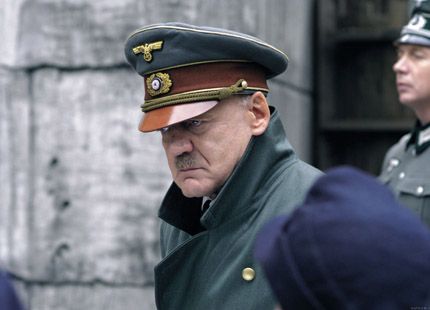
(safecracker, being a scary nazi)
Hey guys, this is what has been keeping me occupied (well one of the things) for the last month. I've finished and i'm proud of it, and i want to post it here. But if you haven't seen Fritz Lang's M, then it won't make much sense to you and will spoil it, so either watch that movie, or read this if you don't care, or wait until i write a review of M, which is one of my favorite movies. ok, film buffs enjoy
The Political Undertones of M:The Murderers Among us John Pruitt
The story of the hunt for a child murderer may not seem inherently political since it employs the plot device of a police drama, but Fritz Lang’s M, made in 1931 on the eve of Hitler’s rise to power, must be viewed through a political lens. Lang focuses less upon the drama of finding the killer and more upon the indirect affect the murderer has upon the society he lives in, and in so doing, exposes not only the life of the city but the lengths this internal threat drives people to. When making the movie, Lang said, “I want to make a movie about people,” and he focuses less upon the singular story of a serial killer, and more on the collective story of human nature, law and justice. Lang’s city becomes a microcosm for German society as a whole.
One of the central themes of M is that the murders have a wide-scale effect on the population as a whole. The murderer isn’t on screen in the early scenes; instead, we learn first of people’s reactions to his actions. The first lines of dialogue are by children singing about some dark monster, immediately followed by two women talking about how the child-killings are on everybody’s mind. When little Elsie Beckman meets her killer, she is looking at a poster outlining his crimes. The murder itself isn’t seen, only the cries of the mother combined with shots of the girl’s balloon and ball, leaving the gruesome details to the viewer’s imaginations. Following the murder, the next scene shows how different characters interpret the paper. The camera cuts from a nervous crowd to a table of gentlemen, focusing upon a specific warning from the paper about the crime: “We must remind you again that a mother’s first duty is to guard her children from the danger which always threatens. Also the danger is often hidden with some attractive treat, candy, a toy; an apple can all be weapons of the killer.” The seemingly unimportant details highlight the paranoia that has overcome the city. The paper reads: “Where is the murderer, what is he like, where is he hiding? Nobody knows, but still he is one of us.” The warnings underline why the police can’t find the criminal, and why the people of the city are so on edge; if the criminal is one of them, then nobody can be trusted. The citizens are tormented by knowing that their kid isn’t safe even in their neighbor thus are more likely to turn to extreme measure to put a stop to this perpetual terror. The line “the murderer is one of us” underlines a secondary theme in the film – that it isn’t quite clear who the murderer is, as the people of the mob are themselves liable to murder.
In a following scene, a crowd reacts violently towards an old man giving the time to a little girl. The mob’s paranoia reveals a city gripped by the need to find a scapegoat. None of the characters on screen have names or any direct relation to the plot, which gives the impression that this scene has been played out many times across the city. Although the accused man is innocent, his house is searched. The exasperated and tired expressions on the policemen’s faces let the audience know that this has become a formula, that searches are taking place all over the city. The camera cuts to exhausted patrolmen being woken up, detectives looking through mountains of paperwork, whole armies exploring forests for clues; the audience is exposed to brief glimpses of the hardships the police are enduring. As dozens of criminals are rounded up in raids, the police use their lack of papers as an excuse to arrest them for other crimes. When the police form a blockade forcing the men to display their papers (unintentionally resembling the checkpoints set up by the SS years later), the petty criminals’ chants about “Papa Loehmann,” the head inspector, which indicated that police popularity is waning due to the amount of trouble they are causing with nothing to show for it.
The result of all of these seemingly unimportant scenes is that when the criminal network gathers in force, the audience understands their mindset. Frustrated by constant raids and feeling humiliated that the police assume the killer is among them, the lower classes are angry. This anger leads them they to hate the child-killer for bringing inconveniences upon them. Their desire to protect their own business interests, combined with their fear for their own children and disgust at the brutal nature of the crimes, provokes extreme measures. Thus, when the meeting does commence, the audience sympathizes with their determination to catch the killer themselves. The newspaper’s question of “who is the murderer?” echoes throughout the film, as both Hans and his hunters can simultaneously be described a killers.
The idea of a city gripped by fear turning to a militaristic criminal element to bring stability draws an obvious parallel to the Nazi’s rise to power -- Hitler would become chancellor of Germany a mere two years after the film’s creation, when it would be banned in Nazi Germany – and, for Lang, the underground criminal government becomes a metaphor for the Nazi’s vigilante thuggery. The concept of a gang of thieves running their own guild wasn’t unique to Lang; the 1928 musical The Threepenny Opera had a similar premise, but the criminals of M are both more efficient and more sinister. The head gangster (in one translation known as the Safecracker) looks like the quintessential SS man, a sharp figure with a sleek black leather overcoat, meticulously groomed and with cold watchful eyes. This image is completed by a hat that casts a shadow over his face, leather gloves, and a cane gripped like a weapon. His every movement is carefully coordinated; in his first appearance, he jerks back from the open door in seconds demanding the curtains be closed. When sitting during the meeting, he doesn’t pace or worry as the other leaders do, but contemplates, not even removing his gloves, which indicates caution, (the viewer remembers the police fingerprint lab seen earlier). His every movement is mechanized and planned out; he never lets his guard down, almost as if he is trying to make himself an inhuman machine. In contrast to the other criminal heads at the meeting, he doesn’t make any mention of a family or of being morally appalled by Hans Beckert; his issue with the killer is business. It’s noteworthy that when the criminals hunt Beckert, Safecracker dresses in uniform and masquerades as an agent of law. Safecracker is the new Germany, a smoothly professional killer who detaches himself from emotions and praises efficiency, a cold man whose moral code disregards mercy or compassion. (Ironically, the career of the actor who played Safecracker thrived under the Nazi regime, and he was later accused of being a collaborator.)
In contrast to Safecracker’s inhuman efficiency, Inspector Loehmann, the head of the case, is tubby, with greasy hair and unfashionable clothes. While Safecracker barks orders, Loehmann paternally asks criminals to “calm down, my children.” Loehmann doesn’t mind seeming eccentric or flawed. When the camera looks up at him from the floor, making him look very unimpressive and ugly, the effect is much different than when Hitler was filmed from the waist up, using a subordinated viewpoint to impress and intimidate. In contrast, Safecracker is filmed in such a manner during the trial scene, in order to empathize his intimidation of Hans.
(see picture above)
Lang’s shot of Loehmann reveals his physical imperfections, yet Loehmann is one of the heroes of the movie; his ethics convey a belief in democracy, justice, deductive reasoning and hard work. Loehmann doesn’t violate the rights of the people under his protection. He protects his city as an agent of the law, as when he questions and tricks the captured criminal rather than using torture.
The criminal movement attempts to lay a scrim of legitimacy over what is essentially vigilante justice. Their justification for going after Beckert is disgust at his actions, but the criminal leaders’ main concerns are finances and their own reputation. Beckert’s actions are “bad for business.” The syndicate operates as a twisted parody of justice, as seen by the mock trial held in the end. In fact, they are almost shown as a second government who operate independently of the police, not trusting the establishment to try Hans Beckert and instead taking matters into their own hands. The Nazi party, at this time, also possessed more members than the German military (due to WWI restrictions), and operated as an independent government. The criminal and police meetings are constantly intercut, highlighting the parallels between the two groups but also their fundamental differences. The camera sharply switches between the official and the criminal meetings, disorienting the viewer. The essential difference between the two operations is authority. The criminals are subservient to Safecracker; they propose ideas, but he makes the final choice as if they were advisors to a king. Later, when an informant is on the phone with one of the lesser bosses, Safecracker simply grabs the phone away and begins issuing orders, contradicting the other with a word. In contrast, at the police meeting, the highest ranking authority figure, the police commissioner, speaks little, trusting his subordinates to do their job, and giving the floor to different officers as they propose an idea. The result this hands off approach is that Inspector Loehmann’s plan is taken seriously and the meeting is a success. The police meeting is an example of democracy at work.
Loehmann, unlike Safecracker, is only a man. The latter seems more ideal than human, while Loehmann is flawed, and yet that is what makes him sympathetic. When he learns why the criminals raided the office building, Loehmann doesn’t instantly know what to do, but has to run to the restroom to compose himself. However, upon his return, he is able to take control of the situation and insure that justice is done. Loehmann hasn’t given up on the value of humanity, and his is a legitimate justice rather than a mockery of it.
Safecracker’s solution ultimately does produce the serial killer and ensure the safety of the children, and yet it is stability at a cost. Like many dictatorships, Safecracker assures the peace of the city by installing a spy network that answers to him, having no accountability with the public. In protecting the city, he has also taken away their right to privacy and due process, instead securing peace based upon force, not individual rights. As far as the gangsters had known, Hans Beckert could have been a father or uncle who liked to whistle and happened to pass the same place on the wrong days. While far fetched, it’s still possible that he could have been innocent, while Loehmann’s method would have gotten the right man absolutely. The democratic system is slow, flawed, and often disorganized, but in the end it represents justice. The syndicate, like the Nazis themselves, wears the mask of a lawful organization, holding a mock trial and trying to catch a killer, but is unable to hide the fact they are a loosely bound group of criminals and thugs, many of whom deserve to be in jail. In the trial scene, Safecracker looks like a gentleman, but behind him are toughs, prostitutes, thieves and murderers, whose response to the defense is to heckle and jeer, surging forward to kill Hans. They are an uncontrolled mob, united in their hatred of an outsider supposedly viler than they are.
The criminals at the trial are like the Nazis themselves, seeking to restore stability but at the price of stripping away humanity and mercy. This dehumanization could be seen as justifiable in the case of a child murderer, and yet, by choosing such an extreme example, Lang undermines the Nazi ideal. Through Lorre’s portrayal, Lang is able to convey that even the vilest members of our race are still human, and pitiable, calling into question the ethics of state-killing. M makes no attempt to mask or justify Beckert’s murders, and yet he is no less human than the criminals who kill for profit, or the police who kill for the law. In fact, in some ways he is more human than Safecracker, who demonstrates none of the weakness or warmth characteristic of humanity. If any character can be deemed a monster, it is Safecracker himself, who for most of the film is considered the lesser of two evils. The shift in Hans’ portrayal also subtly highlights the way movies inherently dehumanize people, playing with the emotions and feelings of the audience. Much like the Nazi propaganda at the time, the film lulls the audience into allowing their respect for humanity to slip away due to the revolting nature of the crimes, to the point that they are willing to see a man torn apart by an angry mob. If Hans Beckert had been beaten to death in his opening scene, the audience’s response would have been one of satisfaction. If he had been murdered in cold blood when following the girls, nobody would have bemoaned his death. M forces the audience to see beyond a pervert’s affliction and recognize his humanity, sick and twisted as it is
Filmed in the age of the Nazi philosophy, the question of Hans Beckert’s humanity is central to the movie, whether he is truly a monster who is beyond any redemption or mercy, or a sick man in need of help. From the opening scene, it is the children who are humming a macabre tune to their game, building the killer into some sort of boogie man. His first appearance on screen is only as a shadow on his own wanted poster with the ominous seductive drawl. His leitmotif, Grieg’s “The Hall of the Mountain King” is a song from the opera Peer Gynt, is about a band of mad trolls hunting down a human, and tells a tale of both madness and claustrophobia. Hans is a monster hunting down innocent humans, while a subtler theme is his being trapped in the hallways of his mind (a metaphor used in his final speech). The leitmotif is used to establish his character on the screen, simply hearing the music signals to the audience that he is present, if not seen, such as when he is stalking a young girl who is window shopping. The murderer is a looming shadow that stalks the unaware, as he stalks the town itself. He acts as a sinister presence throughout the film as the tension and fear on the streets is displayed, and both common people and professionals are shocked by the horrific nature of his crimes.
The fact that the murders aren’t shown on screen but are alluded to, with various characters mentioning “the state they were found…well we all know how they looked.” Hans doesn’t have any lines for the first third of the movie, which is instead dedicated to showing how other characters react and prepare for him, planting spies, investigating leads, and voicing their discontent. Numerous characters, especially the angry mob, refer to Hans Beckert as simply “the murderer” or “the monster,” again stripping his humanity. When the police are taking the pickpocket away, the crowd surges toward him having heard only the word murderer, and many characters in other scenes indicate they want to tear him apart.
Throughout the inter-cut meeting scene with the police and criminals, a limited understanding of his personality is patched together as two dozen people talk for almost ten minutes about him. As the movie unfolds, Han’s Beckert’s personality on screen had been established by his reputation alone, before the visual – his strange almost goofy face and the aural – his whistling – introduces him as an individual. In the same way we associate his leitmotif with his character, we associate his name with a feeling of disgust and anger. Both the police and the syndicate put their plans to catch him into motion before he even appears, giving the audience a sense of inevitability when it comes to Hans’ fate, much as if the viewers have watched the preparation of a trap for a wild beast.
When a police inspector rummages through Beckert’s room and personal belongings, the camera inexpediently cuts to the man himself, looking into a store window. His is a rather chubby and bored face reflected in a store window. Lorre’s unimpressive frame and rather unremarkable presence makes the context of the scene a little hard to understand; he looks like a normal man who is window shopping. The sinister hat and long coat from the first scene now look ill-fitting and plain, and the killer seems almost disappointingly normal.
This changes, however, when he sees the little girl in the mirror, surrounded by a display of knives as an indication of his intentions, and a subtle transformation occurs. His face contorts into a mask of lust and perverse enjoyment, almost a parody of an excited window shopper. When he turns to his victim, his face is again normal, however his reflection is the warped face of a monster, the inner demon underneath this somewhat unimpressive exterior. Then, when his humming of Grieg resumes, he is like a beast on the prowl, and yet the expected chase scene is cut short when the intended prey is intercepted by her mother, and the killer is forced to slip by them, revealing his frustration. Hans has a drink to console himself and rocks back and forth with nervous energy, attempting to resist his demonic urges. The man who was a moment ago was an inhuman hunter driven by lust now resembles a man struggling with an addiction, a pitiful figure. His whistling becomes broken, fragmented, and frenzied, almost as if he is trying to resist the urge to whistle, before finally giving in and resuming the prowl. All of his future scenes are tainted by this brief interlude; he is no longer an inhuman monster who serves as the film’s antagonist, hunting the children without any emotion but lust and rage (like the Tramp from Suspense) , but instead a very awkward and troubled human being. Consequently, the audience is not able to delight in his capture the way they would for a stock killer. During his mock trial, he has become an animal, slowly hemmed in and trapped, and Lang generates sympathy for the monster as Beckert desperately tries to avoid his inevitable capture and murder.
The question of Han’s Beckert’s humanity is one of the central themes of the film, as it calls into question how a society justifies killing, and especially the nature of vigilante justice. Hans’ defense lawyer also points out that Safecracker has killed three people himself, underlining the hypocrisy of their kangaroo court. Han’s verdict was decided before the trial started. When the floor is given to the defense lawyer, he is heckled the moment he starts defending his charge, the mob yelling for him to stop talking. The gangs are only interested in vengeance, and have left behind any pity or sense of compassion. In his final speech, Hans points out that he doesn’t have a choice in his crimes; it’s a compulsion, while the criminals surrounding him are simply lazy and cowardly. His famous line “Who knows what it’s like to be me?” can be seen as a play upon the fact that most of what we know of the man has been a picture painted by other characters; little is understood of Beckert’s own torment. The speech also follows up the earlier café scene, in that it strips away Beckert’s aura of mysterious power. Gone is the menace attached to the serial killer, the monster of the city, replaced by a grown man crying and holding his head, and again the audience is suddenly aware of his humanity and impulsively feels pity. However, standing opposed to his fervent and desperate pleads for understanding are the authorities and the pitiless Safecracker, whose speech of purging this evil -- this man compelled to murder -- is strikingly similar to the Nazi rhetoric of purging “undesirables.” Safecracker has no pity for the mentally ill, and his speech about the failings of the state asylums are like his earlier speech about hunting down the killer without any mercy or compassion. Safecracker is repeating the same cold rhetoric of purging those who are deemed a determinant to society, a status determined by him. Han’s Beckert’s final outburst shows that even individuals who have committed the most heinous of crimes can still possess a shred of sympathy, and that even if the audience, like the detectives, see the worst and darkest parts of his life, that doesn’t mean that they can truly understand what it is like to be him, nor condemn him to an unjust fate. Underneath this theme of reactionary panic of the city, is the danger of innocence. The opening rhythm is sung by the children, who are a symbol of innocence, and later it is a child who both returns Hans’ knife and points out to him the mark upon his back. Hans himself has a strange innocence quality about him, as the children are unknowingly drawn into his trap; he himself is a victim of the criminal’s trap. While most characters are unaware of his true nature, his own broken whistling reveals his identity to blind beggar, who can’t see his humble disguise. When Hans is marked, he looses his disguise, which has kept him from being caught for so long, and is now branded as a beast to be hunted by the encircling mobsters, the mark preventing him from slipping away. Paradoxically, in revealing his true nature as a killer, he gains the pity of the audience as he is hunted and trapped by the mob. Hans, himself, resembles a giant child, both physically, with his wide eyes and pale flesh, and in his mannerisms, from his emotionalism to his inability to control his childish needs and frustrations. In a sense, Hans is a child who has disrupted the game of the adults, and in doing so he has caused them to unite to restore the old order. Much as Safecracker is a parody of justice, Hans is almost a parody of innocence, a victim, but one with blood on his hands.
The theme of humanity is applicable more than just to Hans Beckert, but also to the criminals themselves. Despite the syndicate being a stand-in for the Nazi party, Lang is careful to make clear that with the exception of Safecracker, the criminals are also human. These men and women, who in many films would be simply generic villains, are almost seen as the heroes, protecting the city from the child-killing monster. The earlier scenes underlie the city’s panic and frustrations, making the criminal’s own worries and anger over the murders seem more sympathetic. Many of these criminals are upset at Hans not just because he is bad for business, but also because his cruelty upsets them. The keeper of the pub makes a point to mention that many of the prostitutes are mothers and are offended by the nature of these crimes. When the mock trial occurs, one of the women talks about the emotional horror of losing a child and asks the defense lawyer to consider the feelings of the parents. As she talks about the long nights of not knowing what happened, and the sudden shock, the camera cuts to other criminals, many of who are physically large and misshapen, looking upset and sad by her words, implying they had lost children at some point. The women’s speech ends with her choking on emotion, her face contorted with rage. This scene demonstrates how the very humanity of the mob is what drives them to strip away the humanity of others.
The mob isn’t a political strawman that Lang attacks with impunity. He makes an effort to show that they too are people who are upset and horrified by these crimes. Even the bosses, with the exception of Safecracker, are shown to be very human inside, one mentioning having to look under his child’s bed every night to make sure the murderer isn’t there, and another showing panic at the idea of being tried for murder. With the exception of Safecracker, all of the criminals are visibly upset by the nature of these crimes, and in some part feel that they are doing a civic duty. By showing the humanity of the killer and the vigilantes, Lang makes a point about the complexity of human nature, and avoids dehumanizing any character the way the Nazi’s would. The film makes a conscious effort to avoid stereotypes or caricatures, so that no character is portrayed without compassion. The only exception is Safecracker who consciously strips away his own humanity, and the humanity of those that follow him, as they become bestial in the trial scene. It is the philosophy of fascism that is the true monster.
M reveals the danger of allowing fear and hatred to take precedent over the rule of law and justice, and forces the audience to realize that taking a life isn’t as easy as exterminating an animal. As a film, it shows how easy it is to reduce a human being to something that can be killed without sympathy. It is, in fact, easier to make Hans Beckert into a monster than to regard him as a human, because this requires a conscious effort to sympathize with the killer, to enter the mind of somebody so disturbed that it reflects upon the viewer’s own feelings about sexuality. The real horror of M comes only in part from the killer, but mostly from the men who are mentally stable who are taking charge and advocating the murder of others. M is a movie about justice and the value of the limitations upon vigilantism, and the danger of extremism. The real monster of M is not any one person, but the way individuals can so quickly become a mob bent on vengeance and hungry for blood.
from
EE