Basically, i hope to have a reliable blog where you can read quality reviews on movies/books/video games and what not. Or at least a place where you can pretend the reviews are quality
Why are the two most boring characters given the most screen time?
Radiata Stories (NO I don’t know what Radiata stories means)
Normally I don’t explain why I’m reviewing a game, it’s just an arbitrary decision based upon my whims, and so I’m not going to start now.Nah, just kidding, through that would be funny, instead I have I a whimsical story which serves as a forced metaphor for my views on the game rather than just saying them directly (spoilers, its mediocre).I also love self aware narration.Anyways, I got this game right after I bought a PS2 at my Grandparents, basically as a test game to play something cheap before I went home and borrowed (steal) better (slightly less crappy) games from my friends (people whose addresses I know), and I jus saw my younger sister (younger sister) playing it today when I basically remembered its existence, and figured that since I’m playing assassin and I’m hiding inside my house (there everywhere), I might as well write a review on it, because despite the fact I think the name is silly and I really don’t like the art direction other than character creation, I think it had enough potential to be wroth an article.Basically, I don’t really want to write about what the game is, which is as you’ve noted, a mediocre time killer, but more what it had the potential to be.Because unlike almost every other bad game out there, Radiata Stories faults are born not from lack of creativity or ideas, but simply through general incompetence.And I know that this is going to shock people, but Radiata Stories was possibly one of the bravest attempts in gaming in the last decade.
Now as I have made abundantly clear at this point, I don’t really like JRPG (grr, Final Fantasy) so I’m naturally bias against the game, but it did make some attempts to move away from what normally bothers me, it just didn’t do enough.They ditched turn based combat, but I’m still going into another world to fight and its still limited and tedious, just less so.The outfits aren’t as stupid as Final Fantasy’s absurdities, but they still make everybody look gaudy and out of place, and while the system isn’t as obsessive when it comes to all this minute details, its still boring to the point where I don’t really want to actually modify my character in the least.Beyond that the characterization is simplistic, the dialogue lacks any trace of subtly, and everybody has stupid hair.However it is where Radiata Stories tries to do something original that it all goes horribly wrong.Basically the game has the set pieces to be great.The story is about a young noble boy named Jack Russell (I hope that is more subtle in Japanese) who wants to join the nights of his realm.Unable to get past the entrance exam due to his general ineptitude, he is accepted into the knights through blatant nepotism instead.This got the whole game off to a very good start, because it subverts the normal JRPG, instead of my excitable not so smart character overcoming the odds based on the power of his will, he has to deal with the guilt from his lack of actual merit.This built up the expectation that the game would be about my character trying to come to understand how the world really works and being forced to confront his own privileged background, rather than the main character being the underdog.But like almost everything else in this game, all of these small subversions only serve to disappoint me after raising my expectations because the game doesn’t go anywhere with this idea.Jack has a few seconds of “OMG I don’t deserve this” before going off like the typical JRPG hero non the wiser.Sure he will feel guilty once or twice, but it will come completely out of nowhere and feel like an obvious effort to insert angst. Later once the actual game play starts, this happens again, the castle you start out in is HUGE.Its this massive complex full of different people and stuff happening, it could be a whole game in itself.But you can’t actually do anything with the fact that they have this huge castle because all of the rooms are practically the same and the characters are so dull it just feels like your wasting your time.So, contrary to my nature of saving the main quest until absolute last, I ran to do the main quest before I became more hopelessly lost.Yeah, I know that I missed a massive backlog of important information and potential characters/items, but it was just so generic and uninteresting that what could have been a great beginning.Anyways, so I am then introduced to my party, the snotty rich girl, the overly noble knight and…….my least favorite character the southern hillbilly priest.WTF.Why does every character with a southern accent have to be a dumbass hick?I mean I know this is the fault of the dubbers not the game itself, butI’m half southern, my moms from North Carolina, is the game so bad at characterization they have to use an offensive stereotype.I mean imagined if his character was exactly the same but I made his accent Hispanic.Anyways, I planned to resume the plot summery but honestly, I really don’t care at this point, I just want to talk about the game’s main selling point, the immersion.Basically, the main city (and by extension the surrounded towns when you get to visit them) are all populated by 150 NPCs who you can get into your party.All of these characters have their own schedule and personality and you can collect all of them (Between two play through obviously blah) like lawyer collecting clients through a variety of tasks.These vary from simply talking to them, talking to them at a certain level, fighting them, saving them, having a friend of theirs, to having a special item.The game is run in kinda sorta real time, so you have to pretty much stalk these people before getting them into your party.As you can expect, it suffered from all of the problems you would expect from such a system, namely all of the characters being underdeveloped, existing more as an accomplishment than a party member (you don’t even get to talk to them once you get them in your party), many of them being totally unmemorable, and their listed personally traits never actually effecting the game.For example, I don’t remember his name, but one Frankenstein guy was described as being as sociopathic mad scientist, but once I got him to join me, that never came up, he never betrayed me for his own personal gain or tried to actually experiment on somebody it was just an idea that never came to anything.However the idea is pretty much what I want from an ideal RPG game, if we had a game with better funding and writing backing it, this could be the most innovative game since Baldur’s Gate.Instead we get this idea coming from a mediocre JRPG, where it fails horribly, but at least they tried.And I’m rapidly losing interest, here is some basic information (filler) before I come to the stunning conclusion
The Good and the Bad (wait what else would their be?)
I like that there is a lot going on.People are going into houses, out of houses, regular schedules, and doing their own thing.It makes the society feel alive and people actually having a point.Disturbingly enough, it handled it even better than Oblivion/Morrowind did, by having the characters actually change their reactions when they are in different locations.True is a shallow portrayal that is based entirely upon adding these characters to your friends list, but that’s more than most games can say.
The races.Despite having their art design ripped off from World of Warcraft, Radiata stories actually are pretty fleshed out.Ok, no they are just shallow stereotypes, but they are new shallow stereotypes.The Light Elves are winged fairy elves who are isolationist and snotty.Ok that’s typical, but they are more fairy elves rather than LOTRS Elves.The Black Elves are the tree loving nature elves who are into physical exertion and are kinda a sporty martial artist race who are kinda all athletes.The Goblins are either Green, who are basically an entire race of trashy hobos, or Black who are all stoners, and the dwarves are all Russian industrialists.Apparently there are two types of orcs too, but I never bothered to recruit them.The downside of course is that they are again, only shallow stereotypes, jut with kind of a nifty idea.
The weapons are very much hit and miss, but about half of them are pretty cool.The rest are just stupid
While the NPCs are almost universally shallow representatives of actual characters, they at least have a nifty concept they revolve around.While they lack anything resembling depth, when you first met them they seem pretty interesting.Again, if they actually developed these character you could have bioware styled interesting characters.
A cool plot.This they almost pulled off perfectly, a almost totally morally grey battle between humans and nonhumans.The latter are slightly more morally justified, but that’s like saying the allies were slightly more justified in WWI, its true but the resulting conflict was way out of proportion, as the humans are more likeable honestly.The fact that for the first two thirds of the game you have been making friends on both sides makes the resulting confrontation between the two sides hammers home the feeling of “Wow, this is a civil war, not a war between good and evil”.Of course then you realize how shallow the characters and cease to care, as well as your allies tendency to respawn, which makes the whole point of a civil war kinda pointless.Also the fact that humans get so much more characterization makes all of your non human allies seem weird (Also why are the purple people considered human?Eh?). The problem is that by the end of the game, the purpose or even conclusion of the war are kinda obscured, due to a mix of shoddy story telling and stupidly long periods doing pointless quests.
The quests that involve talking to people and fighting unique foes and interaction between characters was cool, all of the rest were a pointless waste of time
The actual set pieces of the plot were cool, you have these long painful periods of filler intermittently mixed with really good cutscenes that actually make me eager to keep playing (unlike final fantasy games, where I’m just killing time for the whole game).I liked most of the major characters other than jack (see below), the voice acting was good, and while the game didn’t actually make any use of their personalities, they were presented really well in the limited screen time they had.The fact that random NPCs suddenly showed up and made a different was really great, if again, they actually did something with that beyond a few disconnected scenes
The only thing I really didn’t like was the main Character.Jack is simply put, unappealing.Like his namesake, he is excitable, really stupid, moronically brave (I had to use moronically because I had used stupid already), socially awkward and shallow.Basically, the typical JRPG main character, why does Japan love the stupid brave guy with a good heart motif?His lack of intelligence just makes him unappealing, because the random NPCs are honestly more interesting as characters, because he feels like he should be a random NPC who joins your party, because he has about as much depth.This is a massive personal issue I have with JRPGs, but stupid main characters cripple games that rely upon complex stories, because the character himself is unable to actually understand the complexity, thus forcing the game to dumb itself down to the point where it is patronizing.A stupid main character also forces the minor characters to be more polarized so he (and presumably the audience) can understand the conflict better, the main human villain Lord Cross has to be such a massive ass so Jack can know who to fight to.Also its boring, he doesn’t have anything to say, he just follows around from plot point to plot point.A good protagonist is central to a video game of this design, a distinctive personality is vital for this understanding.
So in conclusion, Radiata stories was a brave, but ultimately futile attempt to make something good out of the JRPG format, and to try out some really inventive new ideas.However its departure from the norm made it unappealing to JRPG fans, while its sticking to old traditions made it useless to WRPG fans.So in conclusion, Radiata Stories is more innovative than Dragon Age Origins.While it isn’t as good as a game by a long run, it does something that Bioware didn’t attempt to do, namely try to depart from a formula that has long since proven stagnant.
Look, i don't care how good you are with that, you can't beat bullets with a bat, shut up
Higurashi season two
Now last time,I wrote a flowery review, endlessly praising this anime series to the hilt, so here is where I put on my objective pants and start actually bringing out the actual complaints about the show.First off, the title. Fans of the series will note I’m just calling the seasons basically “Season one and Season two” and aren’t using the proper Japanese names.And there is no way I can say this without coming off as a western ethnocentric elitist, so I’m going to just go with my gut and say, that I can’t understand any of the season differences.The words are very similar, and hard to pronounce, especially for me who doesn’t know more than 4 words in Japanese (long days of watching Kurosawai films has taught me the word for moron through), so its hard to difference, especially for the various “story arcs” within the series, each with its own Japanese title.I just wish fans would translate it, so I can tell what part of the story I’m referring too.But western elitists natureaside, lets move on to other criticisms, and by that I mean season two.
Now if your reading this, you either don’t care about spoilers, or have finished season one, so let me put it here, I don’t hate the second season, I was just really disappointed by it.The first season ended wonderfully, and I know this is a cliché, but after a series of multiple homicides the series finally ends with all of the characters learning the power of friendship and how to work together, and the final episode they all walk off, alive and sane.And I liked that ending.It may have been cliché, but at least it fit the theme of the story, and I don’t mind cliché story endings if I feel like the characters earned it and it wasn’t achieved through massive Deus ex Machina.The characters eventually worked together and over came the curse of paranoia.And I liked that, it fit the theme, it came at a hard cost, and it really explored the theme of friendship vs. isolation within the series.And the second season started off well.After an utterly forgettable first episode, the first arch of the season picks up where the last left off, except the group, having overcome their own internal paranoia and infighting, they eventually try to move on to overcome the sinister nature of the town.They make some headway, but it is clear that the town is still nasty, and then….they die.They all die, the whole lot of them, town wins, and the groundhog loop starts again.And I liked that, I mean, just as I fell into the lure of the heroes being undefeatable not that they have found the power of friendship, then they are all brutally slaughtered.And I’m always a fan of the whole cast being massacred, keeps the audience on their toes.And so we are back to the first seasons formula, of various story arcs as where the characters try to fight against the corruption nature of the town.This season is on a more optimistic note however, as the characters, while unable to remember past lives (except for our heroine Rika of course) seem to have overcome their total inability to trust each other, and are acting more functional and loving towards each other, implying the last season wasn’t a complete waste.The next “life” are almost like repeats of season one, except when the characters are placed into these dangerous situations, they learn to trust people and turn towards others rather than go into paranoia and hatred, except that Statoko’s abusive uncle has returned.The next arc is rather interesting, not even really about restoring the town and overcoming evil, but instead dealing with the actually legitimately hard issue of child abuse.And the series actually handles it rather maturely, showing that the Social Services often don’t know when to step in, and how hard it can be for them to determine actual abuse (especially hard in Japan where the standards are different and blaming the victim is ok), an issue made even worst when the victim often refuses to help.Child abuse is a real life problem that is still pretty hard to figure out, and I applaud the show for not having somebody just beat up the uncle and everything solve itself (a method show explicitly to not work in season one).But there way of solving it, while plausible, doesn’t seem to be very helpful, I mean, most abused children don’t have powerful mob dons ready to step in to help them out.Regardless, the problem is solved, everything is wonderful, and then, yet again, it ends horribly and the cycle goes on again.
Now season two had me going, and I was almost willing to place it better than most, when it shot itself in the foot.They explain the town.You know how the town is some weird evil presence, weather it be gods, or haunted presence, or spirits, but something sinister, mysterious and almost beyond mortal understanding.Hell, it could be in part just insanity in the part of some of the characters, trigged by the town, or maybe not even the town at all.Maybe all of the cast are just nuts, and the town is good, constantly time looping everything.But importantly, it isn’t known and that is why its scary.Its like in the shining, nobody actually really knows what’s up with the hotel, or to how much of an extent its effecting Nickleson, except it is a TV show rather than a movie, and can draw it out more.And yet…..they explain it.And not just in a cool way, they explain it less than half way through the series and call it simply a weird scientific illness that effects people’s brains, but can only grow in this climate and blah blah blah.Now, I like realism, but seriously?Scientific plague?There is time looping in this series, why the hell do you need to a weird scientific explanation.Also having the entire village being a weird government conspiracy and a massive scientific experiment, its just tacky.It ruins any sense of suspense or horror, and makes the whole appeal of the series mute.Most importantly, it ruins the sense of guilt.While the various characters who go mad are clearly influenced by something supernatural, all the magic seems to do is take their already existing urges and desires and amplify them to the point where they are willing to kill other people.But the characters still bear some guilt, Shion is a ruthless, jealous bitch with control issues, and her family problems are still just as real.Keichi is still an egotistical selfish brat who thinks himself above everybody, and Rena is an emotionally disturbed nut with a death wish regardless of weather or not the town is haunted.And yet, by making it an illness you remove any sense of guilt or responsibility from the victims.Jack’s madness in The Shinning is the product of the hotel, but the foundations for his abusive nature were laid before he ever came, it just preyed upon the darkness already in him.Part of the appeal of the show was the feeling that the characters were acting this way because of their own sins, and thus the moral at the end of the first season wall all the more fulfilling, recognizing their faults and moving on.If its an illness, then it should be impossible to ever over come it, and even then the whole point of the show seems wasted.The main villain is revealed to be non other than the nurse to the town doctor Takano.Now don’t get me wrong, she was a pretty nifty side character as the intelligent but clearly mentally disturbed detective, but as a main villain she just comes off as uninspiring, pathetic, and childish.While I like he back story (Horary, Japanese militarism) it lacks any feel of humanity and the “FOR SCIENCE” feel to it just lacks any real punch.The only part of the reveal I liked was that the janitors were revealed to be a tactical military unit, and in the first half of the season are just as sinisterly competent as they were early, with some shocking scenes as they ruthlessly purge the local police.But by the last two arcs they lost any sense of competence and are easily beaten by a bunch of kids.Now, the second to last arc almost redeemed itself, even with the silly premise.The heroes, after defeating the secret service, uniting the town, and discovering the mystery of the illness, the main characters are about to defeat the main villain with afriendship speech to defeat all friendship speeches when…they are all killed by a rapid fire gun.Ok, that’s awesome.And after all the suffering the main characters have endured, I would be inclined to forgive most annoyingly cliché happy endings, but the final arc took it to a level of absurdity that was just annoying.Basically, every character in the entire series showed up to fight the bad guys, and…
Maybe I am somewhat ignorant of the working of the secret service in Japan, but seriously, no matter how good of you are with a baseball bat, you can’t just beat elite agents trained agents with guns.I mean, the main characters take out dozens of elite agents, relying on a few police men, some mob hit men, and things picked up around the house.These guys are elite, they are special opts, there is no way you can justify the ease in which they are taken out.I mean, they have access to machine guns and sniper rifles, and yet seem unable to use them.The last few episodes are essentially a wish fulfillment as the main characters just run through every obstacle thrown at them, and we get to watch the main villains yell really loudly going “this can’t be happening” again and again and again.In short, it was just sort of a flop at the end, and honestly, I’d be happy if the second season never happened.
(safecracker, being a scary nazi)
Hey guys, this is what has been keeping me occupied (well one of the things) for the last month. I've finished and i'm proud of it, and i want to post it here. But if you haven't seen Fritz Lang's M, then it won't make much sense to you and will spoil it, so either watch that movie, or read this if you don't care, or wait until i write a review of M, which is one of my favorite movies. ok, film buffs enjoy
The Political Undertones of M:The Murderers Among usJohn Pruitt
The story of the hunt for a child murderer may not seem inherently political since it employs the plot device of a police drama, but Fritz Lang’s M, made in 1931 on the eve of Hitler’s rise to power, must be viewed through a political lens.Lang focuses less upon the drama of finding the killer and more upon the indirect affect the murderer has upon the society he lives in, and in so doing, exposes not only the life of the city but the lengths this internal threat drives people to.When making the movie, Lang said, “I want to make a movie about people,” and he focuses less upon the singular story of a serial killer, and more on the collective story of human nature, law and justice.Lang’s city becomes a microcosm for German society as a whole.
One of the central themes of M is that the murders have a wide-scale effect on the population as a whole.The murderer isn’t on screen in the early scenes; instead, we learn first of people’s reactions to his actions.The first lines of dialogue are by children singing about some dark monster, immediately followed by two women talking about how the child-killings are on everybody’s mind.When little Elsie Beckman meets her killer, she is looking at a poster outlining his crimes.The murder itself isn’t seen, only the cries of the mother combined with shots of the girl’s balloon and ball, leaving the gruesome details to the viewer’s imaginations.Following the murder, the next scene shows how different characters interpret the paper.The camera cuts from a nervous crowd to a table of gentlemen, focusing upon a specific warning from the paper about the crime: “We must remind you again that a mother’s first duty is to guard her children from the danger which always threatens.Also the danger is often hidden with some attractive treat, candy, a toy; an apple can all be weapons of the killer.”The seemingly unimportant details highlight the paranoia that has overcome the city.The paper reads: “Where is the murderer, what is he like, where is he hiding?Nobody knows, but still he is one of us.”The warnings underline why the police can’t find the criminal, and why the people of the city are so on edge; if the criminal is one of them, then nobody can be trusted.The citizens are tormented by knowing that their kid isn’t safe even in their neighbor thus are more likely to turn to extreme measure to put a stop to this perpetual terror.The line “the murderer is one of us” underlines a secondary theme in the film – that it isn’t quite clear who the murderer is, as the people of the mob are themselves liable to murder.
In a following scene, a crowd reacts violently towards an old man giving the time to a little girl. The mob’s paranoia reveals a city gripped by the need to find a scapegoat.None of the characters on screen have names or any direct relation to the plot, which gives the impression that this scene has been played out many times across the city.Although the accused man is innocent, his house is searched.The exasperated and tired expressions on the policemen’s faces let the audience know that this has become a formula, that searches are taking place all over the city.The camera cuts to exhausted patrolmen being woken up, detectives looking through mountains of paperwork, whole armies exploring forests for clues; the audience is exposed to brief glimpses of the hardships the police are enduring.As dozens of criminals are rounded up in raids, the police use their lack of papers as an excuse to arrest them for other crimes.When the police form a blockade forcing the men to display their papers (unintentionally resembling the checkpoints set up by the SS years later), the petty criminals’ chants about “Papa Loehmann,” the head inspector, which indicated that police popularity is waning due to the amount of trouble they are causing with nothing to show for it.
The result of all of these seemingly unimportant scenes is that when the criminal network gathers in force, the audience understands their mindset.Frustrated by constant raids and feeling humiliated that the police assume the killer is among them, the lower classes are angry.This anger leads them they to hate the child-killer for bringing inconveniences upon them.Their desire to protect their own business interests, combined with their fear for their own children and disgust at the brutal nature of the crimes, provokes extreme measures.Thus, when the meeting does commence, the audience sympathizes with their determination to catch the killer themselves.The newspaper’s question of “who is the murderer?” echoes throughout the film, as both Hans and his hunters can simultaneously be described a killers.
The idea of a city gripped by fear turning to a militaristic criminal element to bring stability draws an obvious parallel to the Nazi’s rise to power -- Hitler would become chancellor of Germany a mere two years after the film’s creation, when it would be banned in Nazi Germany – and, for Lang, the underground criminal government becomes a metaphor for the Nazi’s vigilante thuggery.The concept of a gang of thieves running their own guild wasn’t unique to Lang; the 1928 musical The Threepenny Opera had a similar premise, but the criminals of M are both more efficient and more sinister.The head gangster (in one translation known as the Safecracker) looks like the quintessential SS man, a sharp figure with a sleek black leather overcoat, meticulously groomed and with cold watchful eyes.This image is completed by a hat that casts a shadow over his face, leather gloves, and a cane gripped like a weapon.His every movement is carefully coordinated; in his first appearance, he jerks back from the open door in seconds demanding the curtains be closed.When sitting during the meeting, he doesn’t pace or worry as the other leaders do, but contemplates, not even removing his gloves, which indicates caution, (the viewer remembers the police fingerprint lab seen earlier).His every movement is mechanized and planned out; he never lets his guard down, almost as if he is trying to make himself an inhuman machine.In contrast to the other criminal heads at the meeting, he doesn’t make any mention of a family or of being morally appalled by Hans Beckert; his issue with the killer is business.It’s noteworthy that when the criminals hunt Beckert, Safecracker dresses in uniform and masquerades as an agent of law.Safecracker is the new Germany, a smoothly professional killer who detaches himself from emotions and praises efficiency, a cold man whose moral code disregards mercy or compassion.(Ironically, the career of the actor who played Safecracker thrived under the Nazi regime, and he was later accused of being a collaborator.)
In contrast to Safecracker’s inhuman efficiency, Inspector Loehmann, the head of the case, is tubby, with greasy hair and unfashionable clothes. While Safecracker barks orders, Loehmann paternally asks criminals to “calm down, my children.”Loehmann doesn’t mind seeming eccentric or flawed.When the camera looks up at him from the floor, making him look very unimpressive and ugly, the effect is much different than when Hitler was filmed from the waist up, using a subordinated viewpoint to impress and intimidate.In contrast, Safecracker is filmed in such a manner during the trial scene, in order to empathize his intimidation of Hans.
(see picture above)
Lang’s shot of Loehmann reveals his physical imperfections, yet Loehmann is one of the heroes of the movie; his ethics convey a belief in democracy, justice, deductive reasoning and hard work.Loehmann doesn’t violate the rights of the people under his protection.He protects his city as an agent of the law, as when he questions and tricks the captured criminal rather than using torture.
The criminal movement attempts to lay a scrim of legitimacy over what is essentially vigilante justice.Their justification for going after Beckert is disgust at his actions, but the criminal leaders’ main concerns are finances and their own reputation.Beckert’s actions are “bad for business.”The syndicate operates as a twisted parody of justice, as seen by the mock trial held in the end.In fact, they are almost shown as a second government who operate independently of the police, not trusting the establishment to try Hans Beckert and instead taking matters into their own hands.The Nazi party, at this time, also possessed more members than the German military (due to WWI restrictions), and operated as an independent government.The criminal and police meetings are constantly intercut, highlighting the parallels between the two groups but also their fundamental differences. The camera sharply switches between the official and the criminal meetings, disorienting the viewer.The essential difference between the two operations is authority. The criminals are subservient to Safecracker; they propose ideas, but he makes the final choice as if they were advisors to a king. Later, when an informant is on the phone with one of the lesser bosses, Safecracker simply grabs the phone away and begins issuing orders, contradicting the other with a word.In contrast, at the police meeting, the highest ranking authority figure, the police commissioner, speaks little, trusting his subordinates to do their job, and giving the floor to different officers as they propose an idea.The result this hands off approach is that Inspector Loehmann’s plan is taken seriously and the meeting is a success.The police meeting is an example of democracy at work.
Loehmann, unlike Safecracker, is only a man.The latter seems more ideal than human, while Loehmann is flawed, and yet that is what makes him sympathetic.When he learns why the criminals raided the office building, Loehmann doesn’t instantly know what to do, but has to run to the restroom to compose himself.However, upon his return, he is able to take control of the situation and insure that justice is done.Loehmann hasn’t given up on the value of humanity, and his is a legitimate justice rather than a mockery of it.
Safecracker’s solution ultimately does produce the serial killer and ensure the safety of the children, and yet it is stability at a cost.Like many dictatorships, Safecracker assures the peace of the city by installing a spy network that answers to him, having no accountability with the public.In protecting the city, he has also taken away their right to privacy and due process, instead securing peace based upon force, not individual rights.As far as the gangsters had known, Hans Beckert could have been a father or uncle who liked to whistle and happened to pass the same place on the wrong days.While far fetched, it’s still possible that he could have been innocent, while Loehmann’s method would have gotten the right man absolutely.The democratic system is slow, flawed, and often disorganized, but in the end it represents justice.The syndicate, like the Nazis themselves, wears the mask of a lawful organization, holding a mock trial and trying to catch a killer, but is unable to hide the fact they are a loosely bound group of criminals and thugs, many of whom deserve to be in jail.In the trial scene, Safecracker looks like a gentleman, but behind him are toughs, prostitutes, thieves and murderers, whose response to the defense is to heckle and jeer, surging forward to kill Hans.They are an uncontrolled mob, united in their hatred of an outsider supposedly viler than they are.
The criminals at the trial are like the Nazis themselves, seeking to restore stability but at the price of stripping away humanity and mercy.This dehumanization could be seen as justifiable in the case of a child murderer, and yet, by choosing such an extreme example, Lang undermines the Nazi ideal.Through Lorre’s portrayal, Lang is able to convey that even the vilest members of our race are still human, and pitiable, calling into question the ethics of state-killing.M makes no attempt to mask or justify Beckert’s murders, and yet he is no less human than the criminals who kill for profit, or the police who kill for the law.In fact, in some ways he is more human than Safecracker, who demonstrates none of the weakness or warmth characteristic of humanity.If any character can be deemed a monster, it is Safecracker himself, who for most of the film is considered the lesser of two evils.The shift in Hans’ portrayal also subtly highlights the way movies inherently dehumanize people, playing with the emotions and feelings of the audience.Much like the Nazi propaganda at the time, the film lulls the audience into allowing their respect for humanity to slip away due to the revolting nature of the crimes, to the point that they are willing to see a man torn apart by an angry mob.If Hans Beckert had been beaten to death in his opening scene, the audience’s response would have been one of satisfaction.If he had been murdered in cold blood when following the girls, nobody would have bemoaned his death.M forces the audience to see beyond a pervert’s affliction and recognize his humanity, sick and twisted as it is
Filmed in the age of the Nazi philosophy, the question of Hans Beckert’s humanity is central to the movie, whether he is truly a monster who is beyond any redemption or mercy, or a sick man in need of help.From the opening scene, it is the children who are humming a macabre tune to their game, building the killer into some sort of boogie man.His first appearance on screen is only as a shadow on his own wanted poster with the ominous seductive drawl.His leitmotif, Grieg’s “The Hall of the Mountain King” is a song from the opera Peer Gynt, is about a band of mad trolls hunting down a human, and tells a tale of both madness and claustrophobia. Hans is a monster hunting down innocent humans, while a subtler theme is his being trapped in the hallways of his mind (a metaphor used in his final speech). The leitmotif is used to establish his character on the screen, simply hearing the music signals to the audience that he is present, if not seen, such as when he is stalking a young girl who is window shopping.The murderer is a looming shadow that stalks the unaware, as he stalks the town itself.He acts as a sinister presence throughout the film as the tension and fear on the streets is displayed, and both common people and professionals are shocked by the horrific nature of his crimes.
The fact that the murders aren’t shown on screen but are alluded to, with various characters mentioning “the state they were found…well we all know how they looked.” Hans doesn’t have any lines for the first third of the movie, which is instead dedicated to showing how other characters react and prepare for him, planting spies, investigating leads, and voicing their discontent.Numerous characters, especially the angry mob, refer to Hans Beckert as simply “the murderer” or “the monster,” again stripping his humanity.When the police are taking the pickpocket away, the crowd surges toward him having heard only the word murderer, and many characters in other scenes indicate they want to tear him apart.
Throughout the inter-cut meeting scene with the police and criminals, a limited understanding of his personality is patched together as two dozen people talk for almost ten minutes about him.As the movie unfolds, Han’s Beckert’s personality on screen had been established by his reputation alone, before the visual – his strange almost goofy face and the aural – his whistling – introduces him as an individual.In the same way we associate his leitmotif with his character, we associate his name with a feeling of disgust and anger.Both the police and the syndicate put their plans to catch him into motion before he even appears, giving the audience a sense of inevitability when it comes to Hans’ fate, much as if the viewers have watched the preparation of a trap for a wild beast.
When a police inspector rummages through Beckert’s room and personal belongings, the camera inexpediently cuts to the man himself, looking into a store window.His is a rather chubby and bored face reflected in a store window.Lorre’s unimpressive frame and rather unremarkable presence makes the context of the scene a little hard to understand; he looks like a normal man who is window shopping.The sinister hat and long coat from the first scene now look ill-fitting and plain, and the killer seems almost disappointingly normal.
This changes, however, when he sees the little girl in the mirror, surrounded by a display of knives as an indication of his intentions, and a subtle transformation occurs.His face contorts into a mask of lust and perverse enjoyment, almost a parody of an excited window shopper.When he turns to his victim, his face is again normal, however his reflection is the warped face of a monster, the inner demon underneath this somewhat unimpressive exterior.Then, when his humming of Grieg resumes, he is like a beast on the prowl, and yet the expected chase scene is cut short when the intended prey is intercepted by her mother, and the killer is forced to slip by them, revealing his frustration.Hans has a drink to console himself and rocks back and forth with nervous energy, attempting to resist his demonic urges.The man who was a moment ago was an inhuman hunter driven by lust now resembles a man struggling with an addiction, a pitiful figure.His whistling becomes broken, fragmented, and frenzied, almost as if he is trying to resist the urge to whistle, before finally giving in and resuming the prowl.All of his future scenes are tainted by this brief interlude; he is no longer an inhuman monster who serves as the film’s antagonist, hunting the children without any emotion but lust and rage (like the Tramp from Suspense) , but instead a very awkward and troubled human being.Consequently, the audience is not able to delight in his capture the way they would for a stock killer.During his mock trial, he has become an animal, slowly hemmed in and trapped, and Lang generates sympathy for the monster as Beckert desperately tries to avoid his inevitable capture and murder.
The question of Han’s Beckert’s humanity is one of the central themes of the film, as it calls into question how a society justifies killing, and especially the nature of vigilante justice. Hans’ defense lawyer also points out that Safecracker has killed three people himself, underlining the hypocrisy of their kangaroo court.Han’s verdict was decided before the trial started.When the floor is given to the defense lawyer, he is heckled the moment he starts defending his charge, the mob yelling for him to stop talking.The gangs are only interested in vengeance, and have left behind any pity or sense of compassion. In his final speech, Hans points out that he doesn’t have a choice in his crimes; it’s a compulsion, while the criminals surrounding him are simply lazy and cowardly.His famous line “Who knows what it’s like to be me?” can be seen as a play upon the fact that most of what we know of the man has been a picture painted by other characters; little is understood of Beckert’s own torment.The speech also follows up the earlier café scene, in that it strips away Beckert’s aura of mysterious power.Gone is the menace attached to the serial killer, the monster of the city, replaced by a grown man crying and holding his head, and again the audience is suddenly aware of his humanity and impulsively feels pity.However, standing opposed to his fervent and desperate pleads for understanding are the authorities and the pitiless Safecracker, whose speech of purging this evil -- this man compelled to murder -- is strikingly similar to the Nazi rhetoric of purging “undesirables.”Safecracker has no pity for the mentally ill, and his speech about the failings of the state asylums are like his earlier speech about hunting down the killer without any mercy or compassion.Safecracker is repeating the same cold rhetoric of purging those who are deemed a determinant to society, a status determined by him.Han’s Beckert’s final outburst shows that even individuals who have committed the most heinous of crimes can still possess a shred of sympathy, and that even if the audience, like the detectives, see the worst and darkest parts of his life, that doesn’t mean that they can truly understand what it is like to be him, nor condemn him to an unjust fate.Underneath this theme of reactionary panic of the city, is the danger of innocence.The opening rhythm is sung by the children, who are a symbol of innocence, and later it is a child who both returns Hans’ knife and points out to him the mark upon his back.Hans himself has a strange innocence quality about him, as the children are unknowingly drawn into his trap; he himself is a victim of the criminal’s trap.While most characters are unaware of his true nature, his own broken whistling reveals his identity to blind beggar, who can’t see his humble disguise.When Hans is marked, he looses his disguise, which has kept him from being caught for so long, and is now branded as a beast to be hunted by the encircling mobsters, the mark preventing him from slipping away.Paradoxically, in revealing his true nature as a killer, he gains the pity of the audience as he is hunted and trapped by the mob.Hans, himself, resembles a giant child, both physically, with his wide eyes and pale flesh, and in his mannerisms, from his emotionalism to his inability to control his childish needs and frustrations.In a sense, Hans is a child who has disrupted the game of the adults, and in doing so he has caused them to unite to restore the old order.Much as Safecracker is a parody of justice, Hans is almost a parody of innocence, a victim, but one with blood on his hands.
The theme of humanity is applicable more than just to Hans Beckert, but also to the criminals themselves.Despite the syndicate being a stand-in for the Nazi party, Lang is careful to make clear that with the exception of Safecracker, the criminals are also human.These men and women, who in many films would be simply generic villains, are almost seen as the heroes, protecting the city from the child-killing monster.The earlier scenes underlie the city’s panic and frustrations, making the criminal’s own worries and anger over the murders seem more sympathetic.Many of these criminals are upset at Hans not just because he is bad for business, but also because his cruelty upsets them.The keeper of the pub makes a point to mention that many of the prostitutes are mothers and are offended by the nature of these crimes.When the mock trial occurs, one of the women talks about the emotional horror of losing a child and asks the defense lawyer to consider the feelings of the parents.As she talks about the long nights of not knowing what happened, and the sudden shock, the camera cuts to other criminals, many of who are physically large and misshapen, looking upset and sad by her words, implying they had lost children at some point.The women’s speech ends with her choking on emotion, her face contorted with rage.This scene demonstrates how the very humanity of the mob is what drives them to strip away the humanity of others.
The mob isn’t a political strawman that Lang attacks with impunity.He makes an effort to show that they too are people who are upset and horrified by these crimes.Even the bosses, with the exception of Safecracker, are shown to be very human inside, one mentioning having to look under his child’s bed every night to make sure the murderer isn’t there, and another showing panic at the idea of being tried for murder.With the exception of Safecracker, all of the criminals are visibly upset by the nature of these crimes, and in some part feel that they are doing a civic duty.By showing the humanity of the killer and the vigilantes, Lang makes a point about the complexity of human nature, and avoids dehumanizing any character the way the Nazi’s would.The film makes a conscious effort to avoid stereotypes or caricatures, so that no character is portrayed without compassion.The only exception is Safecracker who consciously strips away his own humanity, and the humanity of those that follow him, as they become bestial in the trial scene.It is the philosophy of fascism that is the true monster.
M reveals the danger of allowing fear and hatred to take precedent over the rule of law and justice, and forces the audience to realize that taking a life isn’t as easy as exterminating an animal.As a film, it shows how easy it is to reduce a human being to something that can be killed without sympathy.It is, in fact, easier to make Hans Beckert into a monster than to regard him as a human, because this requires a conscious effort to sympathize with the killer, to enter the mind of somebody so disturbed that it reflects upon the viewer’s own feelings about sexuality.The real horror of M comes only in part from the killer, but mostly from the men who are mentally stable who are taking charge and advocating the murder of others.M is a movie about justice and the value of the limitations upon vigilantism, and the danger of extremism.The real monster of M is not any one person, but the way individuals can so quickly become a mob bent on vengeance and hungry for blood.
Being There is, intentionally I think, designed like the main character to be hard to classify, in that any commentary towards the movie is reflective of the viewer himself.Being complimentary of the film is either recognizing the genius that is hidden there all along, or perhaps looking for things in the movie they fine personally appealing.Criticisms of course, reflex badly upon the critic, as it makes them seem small minded and unaware of the irony of the film. A critic who calls it boring or simplistic instead looks like a conservative close minded conventionalist (I wish that play on words was clever).Calling the film plotless only makes you similar to the President in the book, who simply can’t comprehend something that doesn’t fit to their narrow minded and bourgeois standards (this film making the pretension of being Avante Guard).Summarily, those who call the film condescending or unrealistic are like Mr. Rand (is that a play on Ann Rand, or the Rand diamond factory?), and thus are simply unimaginative and materialistic, too caught up in their own lives to appreciate the simplicity of the film, or you’re an undereducated plebe.Now I get the film, I see what its about.Chance is a mirror for other people’s egos, people bounce their various ideas off of him, and he also represents the ideal example of Tabula Rassa, a blank slate that absorbs ideals.However, its pretentious, it is trying to be something outside the box, but it follows all of the conventions of a conventional “spiritual” film.
sadly, i can only find time to publish articles i've written anyways, so this is my review of Gladiator
Now Gladiator is one of those films I wouldn’t imagine myself liking.Much like Troy and Kingdom of Heaven, and films in that nature, I can normally make a pretty sound judgment of its quality when I just read the premise.A Roman general in the Mid-Imperial period is caught on the wrong side of a political power struggle as the rightful emperor is disposed by his insane son.The general goes on to fight in the Coliseum as a Gladiator, and gets to kill the Emperor in a single combat duel (oh spoilers, the bad guy dies…..what did you expect), with plenty of fight scenes and blood along the way.And um, that is kinda all true.But while the film is a list of clichés, and plot holes, it has a certain charm that makes you look past that and see an actually good film, in the same way Pirates of the Caribbean was good for all of its Disney roots (and by that I mean the first one, before the fish people and the racial serotypes got involved).It was kinda stupid, but thoroughly enjoyable and had a certain charm to it.But enough of me talking about it, lets go into this film?
Gladiator follows the story of the Roman general Maximus, which roughly translates to “general awesome” who is serving under the last of the “5 Good Emperors” Marcus Aurelius (those of you who know Roman history will remember that everything is down hill from here).The general, who is Russell Crowe out in a battle in Germania (which is, for those of you who suffer from abrupt stupidity, modern Germany).And…ok, the first fight scene is awesome. Seriously, it is nothing short than epic.You know how in “Saving Private Ryan” the only part of the movie you actually care about is the first half hour invasion of D-day and everything after that is rather uninteresting?Well this isn’t that good, but it is close, and does the most important, it defines the period.Seeing that battle literally defines Rome, with ten minutes as the Romans prepare for war, and then this wonderful scene as the German hoards are just mechanically wore away by the stoic Roman military machine.And I have a page limit, so I’ll let you enjoy the awesome scene, anyways, Russel Crowe then goes on to talk to the Marcus Aurelius, who hopes to make Rome a Republic again, because apparently he suffers from historical inaccuracy, and hopes to have Russel Crowe take control until he can restore the Republic.Enter the Emperors nutty son, Commodus, played Joaquin Phoenix, who murders his father and take control of the Empire with the help of the Praetorian Guard (the personal body guard of the Emperor, infamously disloyal), and attempts to kill Russel Crowe, who is able to escape, but his family is murdered, then he becomes a Gladiator and ok, you know the rest.What the movie does to make up for it is in the telling.Russel Crowe has this great way of conveying the emotions of a remarkably static character type, but he is very good at making the character seem human.While he has the cliché stoic “I’m too cool to care” expression, he always seems very sad and forlorn within the role, adding a humoring element.For example, when he does the stereotypical “are you not entertained” shaming the mob speech, instead of doing the whole “grr, I’m macho and have no emotions” he comes off instead as a depressed and broken man who is ashamed of his own impotency.And Commodus is great as well, taking an incompetent and, quite frankly, unbelievably stupid historical figure and making him into a chilling, cunning, manipulative egotist, who is still rather sympathetic.However, the standard plot love interest, whose utterly forgettable name and actor I don’t care to write down ruin most of his scenes, as his heavy acting doesn’t mesh well with her…lack of acting, thus ruining all of her scenes.
But the greatest aspect of the movie I think is just the fact that, while it is a standard action film, it is very well thought out.The setting speaks for itself, I mean it is ancient Rome, but unlike some movies, they don’t totally abuse the awesome background but take advantage of it.In the microcosm of this story, you catch the hints of the macrocosms of the whole empire (you’ve taken 10th grade English, you know what these mean).The republic stands for good ideals, but dies because both its own internal corruption, and the fact that the common people want an Emperor.Rome is ruled by the mob, and by the Praetorian swords, it is the apathy and bloodlust that ruined the empire, and finally the people’s inability to realize that they are in a despotic dictatorship.Also, while there are glaring a historical inaccuracy, the story has a sort of historical parallel. Commodus did not die in a single combat duel obviously, but he did fight in the arena and was killed by a gladiator (through it was an assassination).The movie is full of historical references and shout outs that are rather hard to catch, but give the imprisons that the director really cares, especially in the details, like Russel’s family gods that he keeps close to him.Also, I like how the villain just keeps beating the main characters no matter what happens, ending aside.
Now, my biggest beef is the action.First scene aside, most of the fights hast great set ups, but littler follow through.The camera cuts so fast that the fights come off as disjointed and inconsistent at times, first one being the exception, and it is hard to tell once action from the next, character’s placement changes from shot to shot, and it feels like they are skipping events in the cutting.I’d rather just see the guys fight each other for a minute or second on camera rather than just cutting from odd angle to odd angle then one guy falling over dead. Take the fight with Gaul’s champion, you never actually see them sword fight, you see one of them parry a weapon, then cut to a different angle of Russel Crowe falling down, then another cut and he is standing up, then he wins.
Anyways so in short, it’s not a great movie, nor mind-blowing.But it tells a good story, does good credit to the source material, nice characters and most importantly tells the moral of Rome, a society, very much like ours (disturbingly so, I mean, they have Gladiators, we have celebrities).It never becomes a truly great film, but it is good and entertaining.I feel like if it was made by Italians it would be more interesting, cause the characters would be more corrupt and multi dimensional, but most of the actors can make up for there stock roles with fine acting.In short, a solid B minus, if I had to give an arbitrary grade to it.
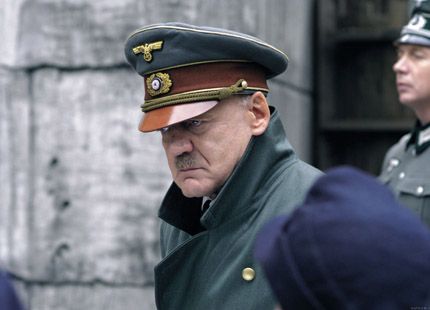
For obvious reasons, the idea of a movie about Adolf Hitler made in Germany is bound to send of warning bells to anybody hearing about the idea, particularly in Germany proper. For the last 50 years, Germany has been trying to make sure that everybody understands that the Nazis were a bunch of evil, ruthless, psychotics and that that was a dark part of their history where they were utterly in the wrong and are trying to move on, unlike some people I could mention (Japan, Russia, Serbia, I’m looking at you). Now, Germany’s attempts to prevent neo-nazism are producing mixed results, but they are certainly trying their best to make sure everybody remembers the Nazis as what they were, genocidal despots. Now, coming from a family of history buffs and having a German Aunt, I’ve read a lot about the Nazis and what they did, how they worked and who they were. So I know that the Nazis not were a bunch of demons who ate babies for breakfast, and were in fact human beings, with families, loved ones and hobbies (Heinrich Himler was apparently a family man), which makes them all the more horrifying for killing millions of people out of some mad mans racist delusions. So I tend to like it when films show the Nazis as people instead of as just mindless villains to be gunned down, as it forces the audience to come to terms with how vile human beings can be. There is a very good reason why Hitler is rarely actually played by an actor in serious films, because people are afraid of making Hitler look either too sympathetic or too cool. Actors can really change how a historical character is viewed, famous anti-Semite (fitting I suppose) Mel Gibson pretty much defines how everybody pictures Scottish revolutionary William Wallace, as a brave hero fighting for freedom, independence, but another actor could easily have shown him as a brutal murdering psychotic who is justly put down by the British, while another could show him as a complex and morally grey figure who does horrible things, but is trying to free his people (the most accurate portrayal I think). 'Downfall' takes place in Berlin as the Soviets are entering and tells the story of the last days of Hitler's he commits suicide. An actor could show Hitler as some sort of brave revolutionary who is fighting against the evil communists for the sake of a greater Germany, which could have some appeal as the Soviets were infamously cruel during their invasion of Germany. In the world of Hollywood, any evil horrible historical figure can still come off as cool as long as their crimes aren't seen on screen, so it isn't a stretch to have Hitler seem like a strong dictator determined to die with his people rather than a delusional despot who destroyed the lives of millions of people, and his own country. It is sort of a custom in Germany to not have an actor play Hitler, but instead show actual film footage of the guy, thus preventing actors from subtly changing the perception of the man. So again, I was kinda worried that an actual actor would be playing Hitler, and showing a more human portrayal, which is much more accurate than the cartoonish evil version of the man we sometimes see (Inglorious Bastards I'm looking at you) but I was afraid of the image of the grandfatherly Fuhrer might catch on unintentionally, making him like the Godfather.
Luckily for everybody, that didn’t happen, the film is awesome. The film follows Hitler’s personal secretary Traudl Junge, in the last days in the Bunker and right after during all of the insanity. I have to say, it was really interesting when, after all I read about Hitler and how he was a human being, a great public speaker, and all of his more human elements, and yet in the first scene when he came through the door, I simply had a feeling of justvile. Like I had been over come with something that made me sick, just disgusted in seeing the man come to life. And the depiction of him is actually really impressive. Bruno Ganz plays Adolf Hitler, and does a very good job of displaying both the human side of Hitler, the devilish charisma that made men follow him, but makes no effort to try to justify his actions or hide the fact that the man is clearly insane. One of the dangers of showing Hitler during his last days is, at that point the worst of the Nazi atrocities have already ended. The film can’t show the Death Camps, or the ghettos or the massacres, at this point they are victims of the Soviet brutality, and so the Nazis look more sympathetic, as they are fighting, admittedly heroically against the huge army of Soviets, who were a ruthless and brutal enemy in their own right, through still below the Nazis. But Ganz does a great job of showing how nuts Hitler is, and reminding the audience that despite how we might sympathize with these trapped and desperate men, Hitler is still a ruthless sociopath. Again and again we see him ordering his men to their death, murdering men for disobeying orders, even when those orders are insane (charging superior foes for example), killing German civilians in order to make sure Germany goes down with the Nazis, and demanding that Germany fights to the death, happy that he will ruin the country. Gantz also gets the infamous voice and Austrian accent right, chillingly so, to the point where the characters temper tantrums can make a viewer jump. And, even through they show the human side of Hitler, I think it is far more effective in hurting Neo Nazi causes than making him into some sort of evil messiah, a sort of Voldemort super man of evil who is brought down by the powers of good, but instead he comes off as a man, a broken leader whose disoriented and bipolar strategies only squanders Germany’s strength. Because he is a man, you despise and hate him, but also pity him, because quite frankly, he is a pathetic, a lonely, deeply disturbed individual who can’t be happy with anything, and loves nothing. It ruins the mystique of him being some sort of super villain, which would make him almost cool in the way a really dangerous story book villain is kinda cool.By demonstrating Hitler’s real nature, as a mad man who can’t handle his job (commanding units that only exist in his head, refusing any sort of negotiation, not allowing civilian retreat) Hitler loses his ability to be impressive, and just becomes a weak, pathetic, broken old man.
The portrayal the entire Nazi regime was really good.In the Bunker, a sort of microcosm for the entire nation, you see men like Goering and Himiler who are already abandoning their master for the chance to salvage something from the wreckage , you see some like the bald Doctor who are trying to help the civilians as much as possible and get sick with the regime, and then the Air Marshal guy who are loyal to Hitler but not to the cause.And then you have Speer, who is loyal to the man, but don’t obey his orders, and finally Goebbels (and family) who follows him to the bitter end, eventually committing suicide after Hitler's death.The movie is, to say the least, a little hard to take in one sitting.When it comes to historical films, I don’t mind spoiling the ending, but the entire experience of watching the Nazis' confused and chaotic scramble in the regime’s death throes has some really emotional scenes, such as when Frau Goebbels making her self the second most hated character next to Hitler when she poisons her six children because “A world without National Socialism is not worth living in”, not to mention the scene where various Nazi members shoot themselves.There is one scene where an officer is trying to get some men to assist him, and one of them says “I’m sorry sir, I can’t” before eating his own gun.Or the scene where one general, not allowed to retreat from Berlin, and knowing the Russians are coming, blows himself up while he is eating dinner with his family. Not to mention the panicked and paranoid shooting of “deserters”, throughout the film. The movie is makes the point that the Nazi inner circle was a nut house, And in real life, the Nazi party was a chaotic, ineffective, disorganized den of madness and infighting, with blind loyalty being contrasted with unimaginative back biting, with a total lack of compassion for other human beings.In general, it is a great way of showing the dysfunctional and chaotic nature of Nazi regime and those within it.
Just general notes about the film, I like how they showed the details of the Nazi party.From the really complicated inner politics, to the fanatical loyalty, to the infighting, it really felt like you were looking into the heart of darkness, into this bizarre and alien world, where the protagonist is trapped.Just a general side note, I loved the uniforms.And I don’t just mean the costumes, cause those were based after the real ones, but the actual uniforms.I’m not a Nazi sympathizer in any sense of the word, but, evil as they are, the Nazis uniforms are cool.I mean, even in all the chaos, you can’t help but noticed how awesome the guys look walking around in these fancy outfits with those large boots clicking everywhere, even the SS with those absurdly cliché skull and crossbones look pretty epic with there intimidating outfits.I mean, it helps you understand the appeal of the military complex in Germany, because pretty much anybody can look badass in one of those uniform, especially when they are contrasted with the ill-fitting and awkward looking appeal of the Soviets.Through it does help me appreciate our own military (US), for how utilitarian our suits are, its kinda avoiding that sort of romanticized militarism.
Also, there is pretty much no background music in this film, which is really good.If there was music added to this film, the Battle of Berlin would seem dramatic, a heroic last stand against the Soviet menace against the brave and fearless Germans, who are determined to not go quietly into that good night.You could have Hitler’s body being burned with a sense of glory and accomplishment, you could have Goebbels suicide being tragic and remorseful, you could have the coming of the Soviets seem like the approach of some sort of evil army (which you could argue they were, the Soviets were horrible, but far less worst than the Nazis).The movie would be what the Nazi’s wanted their final days to be remembered as, a sort of Spartan like last stand against the Asian hoards, despite all dying in the end in a Wanger like sacrifice, a bit like 300, and by that I mean that film is something that would come out of the Nazi film industry (Frank Riefenstahl Miller) .Instead through, the lack of back ground music maeks the last days seem not herotic, but pathetic.The burning of Hitler’s body doesn’t seem like a dramatic Wagner Viking style ending for a great hero, but simply a body being dumped in a whole and having brainwashed men burn it before being driven away by gun fire.The meetings with Hitler doesn’t feel like a frustrated man who is being forced to have his people fight to the last, but instead an uncomfortable talk with a maniac who is running everything.The scene feels more human, more real, and helps the audience sympathize with the protagonist as she is trapped in a world that she only just realizes has been crazy from the start, and wants to get out…but doesn’t know how.The Nazi’s last days, like Hitler himself, seem a pathetic and impotent force that is only waiting for a stronger power to finish it off.
The film in my mind has two faults.First off, they don’t introduce many characters.I recognized a lot of the more famous ones, but a lot of minor characters are hard to keep track of, and as they don’t’ all look like their historical counterparts, it’s a little hard.The real Goebbels for example, was very short and had a limp, while this one walks fine and is very towering.And finally, the only major historical inaccuracy, is that the film doesn’t show the brutalities of Soviets.Now I know that wether Traudl Junge escaped or was captured and raped is disputed, but the Soviets were brutal in their conquest of Germany, as Germany was brutal in their invasion of Russia. Mass rapes, torture, massacre of innocent German civilians, the Soviets were horrible. If it wasn’t for the far worst crimes of the Germans and Japanese, the Soviets would seem like the most inhuman monsters in the war (but seriously, how do you compare with Death Camps and Nanking). Now I am not denying that the Nazi were even worst to the Russians when they invaded the Soviet Union, but as it is, that doesn’t justify the Soviet brutalities (or the American ones for that matter, though ours are mostly against the Japanese), and as it is, the nature of the Allies brutalities are kept in the dark.I mean, the Axis were the most evil force produced by human nature, but I think its wrong to paint the conflict as black and white, it was more grey vs. black, as the allies did horrible things, and which should be noted.Denying it, just makes us abject hypocrites.That being said, I understand why this film didn’t do it, because by showing the Soviet atrocities, it makes the Germans seem more justified and heroic, and the film would want to avoid that.But in the end, this movie is a chilling and fascinating look into the Nazis when all of there delusions of grandeur were stripped away.
 Why are the two most boring characters given the most screen time?